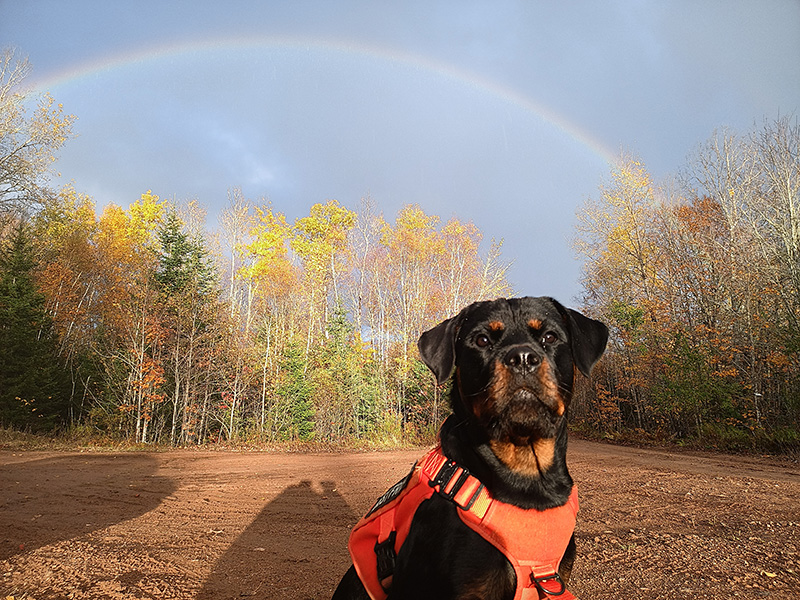
It All Started with a Dog and a Walk in the Woods
Sasha — my high-energy Rottweiler — lives for our daily forest runs. She especially loves winter. The colder, the better. With her bounding through snowdrifts and me trudging behind, we spend hours exploring the birch forests of Nova Scotia together.
One frosty morning, I spotted a large chunk of chaga growing on a birch tree. I knew what it was — chaga had been on my radar for years. But once I started looking, I kept finding more. Day after day, walk after walk, I was stumbling across enough wild chaga to supply not just myself, but my friends and family for life.
"That's when I realized this wasn't just a lucky find — it was nature offering something powerful that needed to be shared."
So East Coast Chaga was born. Just one man and his dog, hiking deep into the woods, sustainably harvesting wild chaga by hand. We harvest only in the cold months — when the trees are dormant and the chaga is at its peak potency. We always leave at least 20% of each growth behind so it can regrow and the forest stays balanced.
It's slow, cold work. Some mornings the temperature is well below zero and the snow is thigh-deep. But every time I look down at a bag of finished, vacuum-sealed chaga powder — knowing exactly where it came from, exactly how it was handled — it's worth every frozen step.
The King of Medicinal Mushrooms
Chaga (Inonotus obliquus) is a parasitic fungus that grows on birch trees across the boreal forests of Canada, Russia, and Scandinavia. It has been used for centuries in folk medicine — as a tea, a tonic, and a daily wellness ritual. Modern research has begun catching up with what northern peoples have known for generations.
Wild-harvested chaga contains some of the highest concentrations of antioxidants found in any natural substance — up to 40 times more than blueberries. It's rich in beta-glucans, betulinic acid, polysaccharides, and melanin compounds. We believe the best chaga is the chaga that grows naturally, in the wild, on a living birch tree.
How We Process Every Batch
Ready to Experience East Coast Chaga?
Small-batch. Wild-harvested. Vacuum-sealed. Shipped with care.